Picture this. The interior of a 7-Eleven: it’s the early 1980’s, late afternoon — a weekday after school. Half-a-dozen Junior High age kids with Mt. Dew Big Gulp’s in their hands and quarters in their pockets are queued up to play Pac-Man on a standup arcade machine tucked away in the corner of the store.
No mobile phones, no PlayStations, no Nintendo Switches in sight. No ChatGPT. Just imaginations and lots of quarters. Lots and lots of quarters.
To Celebrate Pac-Man’s 45th anniversary on May 21, I’d like to fondly look back at a video game that will never be forgotten. Masterful in its simplicity, addictive in its gameplay, and impressive technologically for its time, Pac-Man remains a cultural icon.
A Brief History
Absurdly named Puck Man in Japan, the game made its way to the United States courtesy of Midway, a licensee of publisher Namco America. Renamed Pac-Man in 1980 it remains as one of the best selling video games of all time, estimated to have earned billions of dollars in revenue.
Developed by a small team in a year’s time, the game was written in assembly language for the Zilog Z80 8-bit CPU. With just 20KB!?! of total memory, the game had to make efficient use of limited resources.
Simple Yet Highly Complex Under the Covers
If you just arrived on the planet Earth and are unaware, Pac-Man gameplay is simple and much remains the same from round to round.
Static design elements:
- A consistent maze pattern filled with associated dots and power pellets plus two side tunnels.
- Four ghosts of varying “intelligence.”
- A valuable, consumable fruit chosen from a small set of alternatives.
What does change contributes to the difficulty level in a seemingly straightforward way.
Advancing to the next round simply accelerates everything on the board: ghosts and Pac-Man himself move faster, while the transformed blue ghosts witness a decreasing expiration time. Fruit becomes more valuable. Ghost intelligence, however remains fixed.
As it turns out, what might seemingly become repetitive and dull becomes challenging and addictive as players try over and over to achieve the high score and get a taste of those ridiculous cut scenes (more on that later).
Assembly Language Code
To get a feel for how difficult it must have been to write a game like Pac-Man with ridiculously low resource constraints (by today’s standards) and virtually no development tools to think of, we have to talk about Assembly Language.
Just to give you a taste, here’s a simple Assembly subroutine that adds some values, moves them to a register and stops execution:
; Sample Z80 assembly program
LD A, 0x15 ; Load the value 0x15 into register A
LD B, 0x22 ; Load the value 0x22 into register B
ADD A, B ; Add the value in register B to register A
LD C, A ; Load the result from A into register C
HALT ; Stop execution
No object orientation, no memory management, limited debugging, and no VS Code for editing. We’re talking 1000’s of lines like this. It’s challenging, to say the least, to write code this way. If you’d like to dive in there’s a fun Medium article about a student project to recreate the game. They create a Pac-Man knock-off on the x86, which will give you a feel for the difficulty involved.
For our Finale: The Somewhat Disturbing Cut Scenes
Every few rounds the Pac-Man gamer is presented with a seemingly innocuous, animated intermission. You can watch them all. We’ve got a ginormous Pac-Man chasing a smaller version of himself after round 2. Then when we finish round 5 — surprise — we get this disturbing scene:
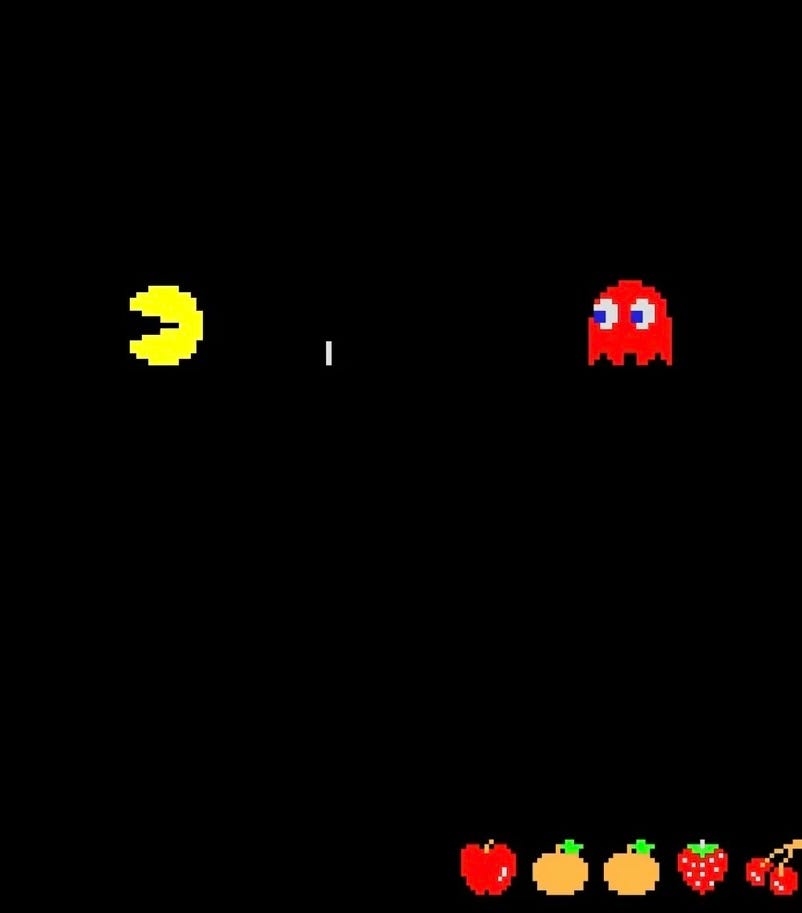
Our hero Pac-Man flees from Blinky the red ghost and glides past an unknown object (a nail?) unscathed. Blinky is not so Lucky.

It gets even more bizarre.

This later cut-scene is so strange, I’m unable to explain it. Most players never reach this point in the game (I know I never did), only an advanced player will witness it. Perhaps it’s better that way. I’m guessing it was meant to be humorous? It’s difficult to unsee though but still a great game.

No comments:
Post a Comment