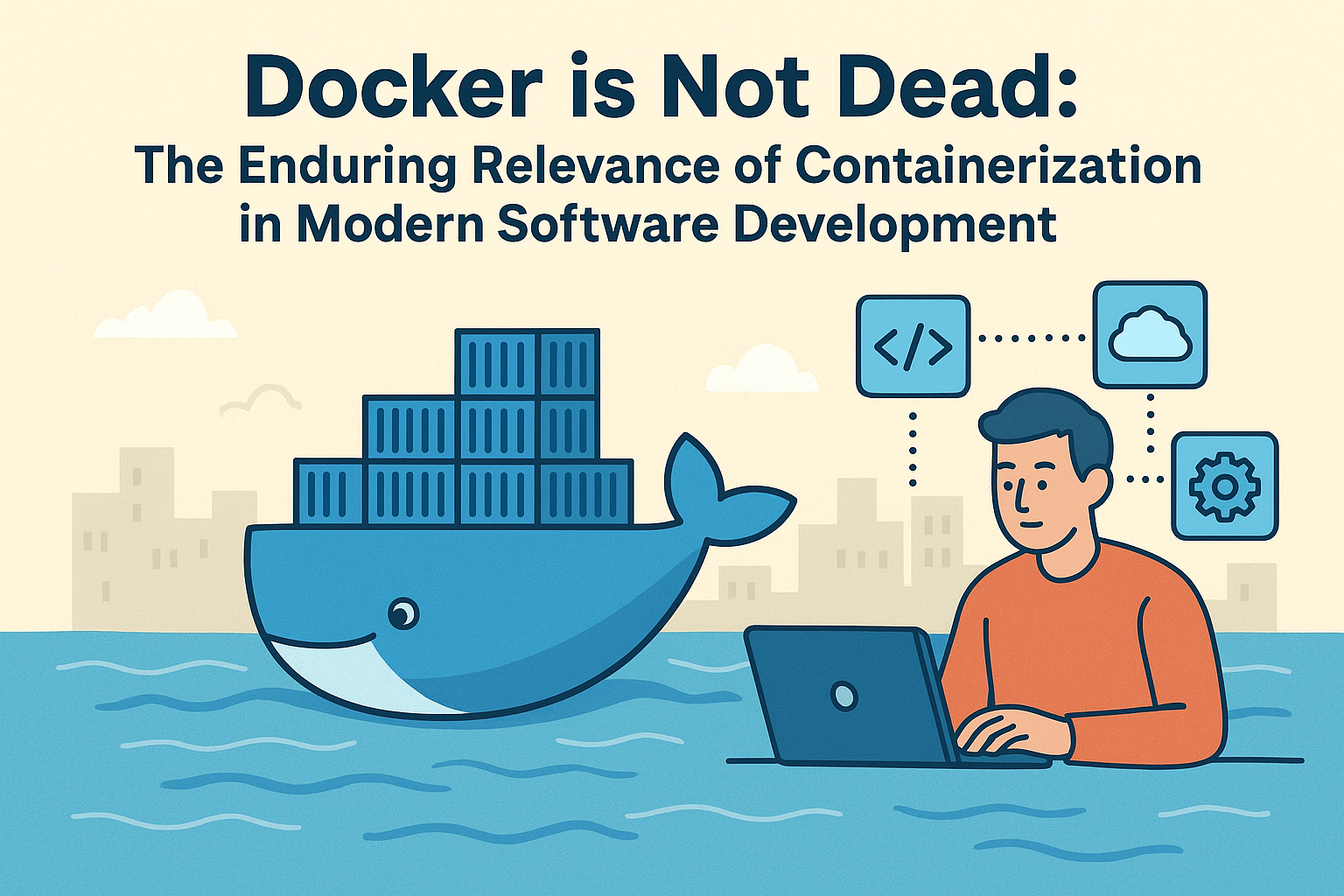
Introduction: Debunking the “Docker is Dead” Myth
Lately we’ve seen some click-bait articles suggesting Docker and even containerization itself is on its deathbed. Let’s address the recent conversations and misunderstandings surrounding Docker’s role and how important it is in our current environment.
First, keep in mind we’re not addressing the health or future of Docker the company. That’s a business world question we’ll save for another day. Instead let’s focus on Docker the containerization technology.
I posit this: Docker is not only alive and well but is a more critical tool than ever for both developers and operations teams in the age of generative AI and Kubernetes.
The Foundational Promise: Consistency and Portability
The days of “it works on my machine” are gone. Containerization, via the Dockerfile specification, packages an application and all of its dependencies in a single, isolated, and easily reproducible unit.
Regardless of the underlying operating system environment (macOS, Windows, Linux) the container runtime works to provide a consistent environment that manages the complete container lifecycle: it creates, starts and stops containers, pulls and stores images, configures mounts and networking, you name it.
The Developer’s Workflow Revolution
VS Code Dev Containers
Dev containers in code editors like Microsoft’s open source VS Code allow devs to have a pre-configured, shared, consistent, and isolated dev environment on a per-project basis. Each project can have its own container tailored to the unique needs of the application. It’s almost trivial to start up or tear down an existing project.
Dev containers make onboarding new team members a breeze — no need to spend hours installing packages, solving conflicts, and configuring various settings. Simply pull the project from version control and build the development image.
A Clean Local Environment
Docker prevents “dependency pollution” on a developer’s local machine. Gone are the days of installing multiple versions of languages or databases locally on a machine, hoping that our desktops won’t buckle under the conflicting settings and configurations requiring yet another fresh OS install.
From Development to Deployment: The Operational Advantage
Using official, well-maintained and tested base images (e.g., node:18-slim, python:3.10-alpine) we can minimize vulnerabilities and take advantage of new features without too much downtime. These images are already optimized, tested, and secure, providing a trusted foundation.
Security and Patch Management
We all know the importance of keeping software patched and secured. Docker and containerization makes updates and dependency management easier. Coupling this with Kubernetes and a DevOps pipeline, we can check in updates to version control and watch our changes automatically become live on our test and deployment clusters, provided our code and the associated images pass necessary security checks.
The Seamless Path to Production with Kubernetes
As alluded to above, in the modern container orchestration ecosystem, Docker can play a crucial role. Once we’ve containerized our applications, these building blocks can be orchestrated and scaled with Kubernetes via a DevOps pipeline to automate deployment.
Technologies like Podman and Buildah are Simply Docker Variations
Some may argue that Docker is being “replaced,” but hear me out. Docker fundamentally does two things:
It Builds images (docker build) and runs containers (docker run).
Buildah + Podman simply split those same responsibilities:
- Buildah =
docker build - Podman =
docker run/docker ps/docker exec
They remove the daemon but use the same underlying standards
- Docker popularized the OCI (Open Container Initiative) image and runtime format.
- Podman and Buildah build and run OCI-compatible images and containers — the very same artifacts Docker produces.
From a developer’s perspective, whether the image came from Docker, Podman, or Buildah doesn’t matter — it “just works.”
But Docker Desktop is no Longer Free!
This argument in favor of abandoning Docker is a bit misleading. Yes licensing for Docker Desktop has changed. Commercial use of Docker Desktop in larger enterprises (more than 250 employees OR more than $10 million USD in annual revenue) requires a paid subscription. However, there are lots of open source alternatives — we mentioned Podman above as one example.
Another option is Docker Engine or Docker CE (Community Edition) which is an open source project, supported by the Moby project maintainers and community members. It’s available for lots of different Linux distributions and Windows. And Docker Desktop is built on top of it! Compose is also available without a license. So if you want to remain fully open source, the tools are there.
Conclusion: Docker’s Permanent Role in the Technology Stack
Hopefully this article has shown how Docker and container technologies like it are not a fad, but a foundational technology that underpins modern on-prem and cloud-native development.
Developers benefit from consistency, ease of code sharing, and less installation headaches.
DevOps engineers enjoy portability, security, and scalability with fewer maintenance and support problems.
Docker’s future is secure because it has become an indispensable, low-level component of the software development and deployment lifecycle.

No comments:
Post a Comment